
Jujutsu
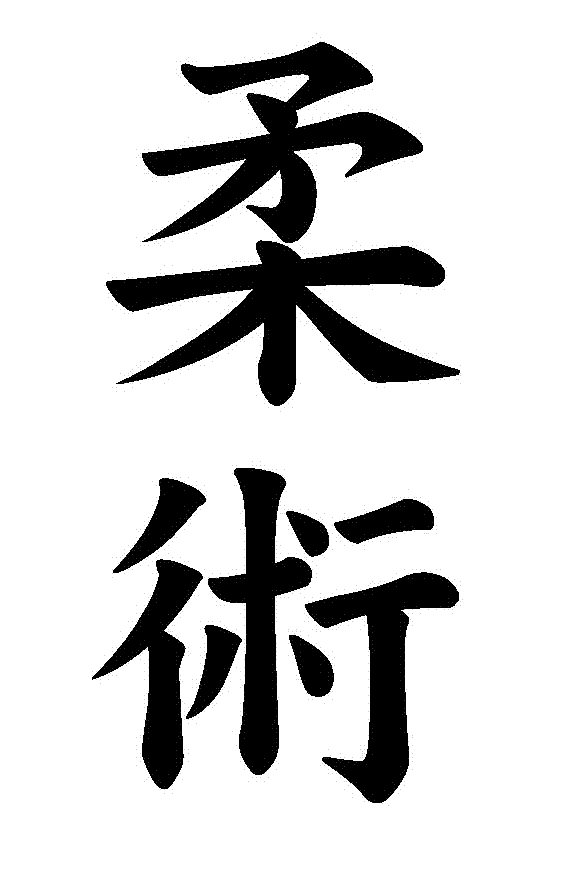
Jujutsu is a Japanese martial art, the origins of which go back to the warriors of feudal Japan – the bushi, nowadays called samurai. Jujutsu can be translated as “flexible art”. This represents one of its core principles: that of using an opponent’s energy against them, rather than opposing it directly. When applied skilfully, jujutsu is used to neutralise an attack with minimal effort and thereby can allow a practitioner to overcome a larger or stronger opponent. Jujutsu primarily employs throws, joint manipulations, and immobilisation techniques.
Shindo-Ryu
The style of jujutsu we practise is called Yamanaka-Ha Shindo-Ryu Jujutsu. Shindo-ryu developed from Yoshin-ryu jujutsu (founded in 1642), one of the three largest jujutsu schools of the Edo period (1603 – 1868). Ronald Yamanaka, after whom our particular version of Shindo-ryu is named, studied under Masaru Shintani (1927-2000) who was a student of Hironori Ohtsuka (1892-1982), the founder of Wado-ryu karate. Shindo-ryu jujutsu includes standing (tachi waza), kneeling (suwari waza), and ground-based (ne waza) techniques.
Shindo means “new way” and is a modern style of jujutsu, built on traditional techniques. We train jujutsu in a traditional way but informed by a modern understanding of movement best practice to ensure safety and longevity in training.

Embujo
Embujo is the term used to describe the centre of the dojo (training hall), the space where training takes place. But it has a deeper significance.
Certain strands of Taoist philosophy were influential in the development of traditional Japanese martial arts, such as jujutsu. When viewed from a Taoist perspective, embujo can be associated with the element earth and the principle of honesty. The same connection is manifest in the phrase “down to earth” and the word humble, which derives from the Latin word humus meaning earth or ground.
Embujo, as the centre of jujutsu practice, is where controlled conflict is initiated and resolved and where jujutsu practitioners are called upon to give their best, without pretence or excuse. In embujo, students develop and test both their technique and martial spirit. To perform jujutsu in embujo is to voluntarily confront one’s own limitations and develop an honest, grounded sense of oneself.
 Embujo